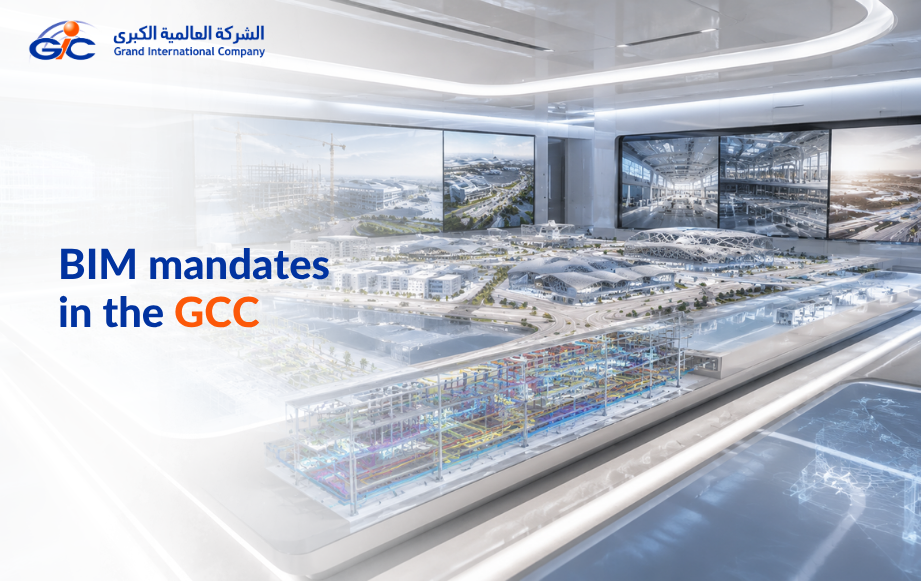

A few years ago, BIM was something many companies explored to improve project coordination. Today, for many projects across the GCC, it is becoming an expectation.
Governments continue to invest in major developments, from hospitals and airports to educational institutions and large infrastructure projects, so BIM requirements are becoming more common. Dubai has already introduced BIM mandates for several categories of complex projects. As a part of Vision 2030, Saudi Arabia is also making BIM adoption mandatory. Why? Projects grow larger, timelines become tighter, and teams are expected to work together more efficiently than ever before.
Today, many organizations across the GCC region are familiar with BIM. But they find it difficult to use it properly across teams, projects, and day-to-day workflows. Grand International Company (GIC) Middle East helps organizations build practical BIM processes, train their teams, and prepare for the growing BIM requirements across the GCC.
Quick Summary: What GCC BIM Mandates Usually Expect?
In most GCC projects, BIM is no longer treated as an extra skill. It has become part of how the work is actually delivered. And while each country or authority may word things differently, the expectations tend to follow the same direction.
Defined BIM maturity levels
Many projects don’t just ask for “BIM use.” They expect a certain level of discipline in how it is applied. Level 2 is commonly recommended. In simple terms, it means different teams don’t work in isolation. Everyone works on a shared platform for better coordination and systematic updates. So mistakes are caught earlier, not on site.
Global BIM standards like ISO 19650
You’ll often see standards like ISO 19650 mentioned in requirements. This is basically a way of saying: “we want everyone to manage project information in a clear, structured, and predictable manner.” It helps avoid confusion when multiple consultants and contractors are involved.
Open formats such as IFC and COBie
Projects in the GCC often involve different software tools across teams. IFC and COBie formats help bridge that gap. These formats allow information to move from one system to another without losing important details. This becomes more important when the project changes hands later.
Common Data Environment (CDE)
BIM projects now require a shared digital space for sending emails or providing updates. A CDE functions as a single control point for everyone to use the latest approved drawings and models.
Better day-to-day collaboration
BIM mandates also push teams to stay connected in real time. Architects, engineers, and contractors are expected to coordinate continuously rather than working in separate silos and fixing issues later.
Digital handover at project close
At the end of a project, clients don’t just want drawings anymore. They expect as-built models and structured asset information that can be used for maintenance and operations.
Thinking beyond construction
BIM data does not stop at project completion. It can support the building or infrastructure throughout its life(repairs, upgrades, and long-term management).
Consistency at every stage
From design to delivery, teams are expected to keep information clean, up to date, and reliable so it can be trusted at any point in the project lifecycle.
The gap between “doing BIM” and “doing BIM the way GCC clients expect” is becoming more visible.
This is why companies cannot treat BIM as a software upgrade anymore. It needs planning, training, process alignment, and the right implementation support. The firms that take this seriously are already finding smoother approvals, fewer coordination issues, and better trust from clients.
Going forward, BIM in the GCC will not slow down. It will only become more structured and more demanding. The real question for companies is not whether they should adopt it—but how quickly they can make it part of everyday project delivery.
What Should GCC Companies do to Cope With This Shift?
To stay aligned with BIM mandates in the GCC, companies need more than awareness. They need a working system that fits real project conditions.
This includes clear execution plans, trained teams, standardized workflows, and the ability to manage project information in a controlled and consistent manner. Without this, even good design teams struggle to meet client expectations during delivery.
Role of Grand International Company (GIC) in Supporting BIM Adoption in the GCC
BIM in the GCC is no longer about software installation or isolated training. It has become a full shift in how projects are designed, coordinated, approved, and handed over.
Most organizations understand the mandate. The challenge is execution.
This is where GIC steps in—not just as a service provider, but as a BIM implementation partner working alongside project teams through every stage of transformation.
As a certified Autodesk Gold Partner, Grand International Company Middle East supports AEC organizations in translating BIM requirements into real project workflows. This includes aligning teams with international standards like ISO 19650, improving coordination practices, and setting up structured digital environments that match GCC project expectations.
Instead of treating BIM as a standalone activity, GICME focuses on integrating it into daily project delivery—where design, engineering, and construction teams actually collaborate.
Turning BIM Requirements into Real Project Practice
Most GCC BIM mandates expect more than models. They expect:
- Controlled information flow through Common Data Environments
- Coordinated multi-discipline models
- Standardized documentation and execution plans
- Reliable data for handover and facility management
GICME helps organizations build this structure from the ground up.
Through BIM strategy development, execution planning, and workflow setup, teams are guided to move from fragmented processes to a more connected project environment.
End-to-End BIM Services That Support the Full Lifecycle
GICME’s role extends across the entire project lifecycle—not just design.
From early planning stages to final asset handover, services are structured to support real project demands in the GCC, including:
- BIM implementation strategy and execution planning
- Model creation, coordination, and clash detection
- Design development and construction documentation support
- Quantity take-off and cost-related BIM workflows (4D/5D integration)
- As-built documentation and structured digital handover packages
- Facility management integration using COBie and IFC standards
- Scan-to-BIM and digital twin workflows for existing assets
- Autodesk ACC / BIM 360 setup for project-wide collaboration
- Template creation and standardized BIM environments for consistency
Each service is designed to address a specific gap that organizations face when complying with BIM requirements in real projects.
Why Choose GIC?
- Authorized Autodesk training center with industry-recognized certification support
- Autodesk Gold Partner with proven regional expertise
- Multi-location presence for better accessibility and support
- End-to-end BIM services from strategy to execution
- Practical implementation support for real project workflows
Companies that adapt to the BIM mandates in the GCC early will find it easier to win projects and manage delivery without last-minute pressure.
FAQs
A. Because large-scale developments need better coordination, data control, and long-term asset management.
A. No. It now extends into construction and even facility management after handover.
A. Aligning internal workflows with client-specific BIM requirements and standards. Companies like GICME can help you do it very well.